Exempt or exonerated: the difference on an electronic invoice
Which sales go without IVA because of the product, which because of a customer's document and which by law, with Costa Rican examples.
A customer asks you not to charge IVA. Before removing it, find out why: a sale can be exempt (exento), exonerated (exonerado) or not subject to the tax (no sujeto), and a public university pays 2 %. They are different cases, invoiced differently, and they change how much of the IVA on your purchases you can credit. This guide helps you recognize each one with common examples in Costa Rica.
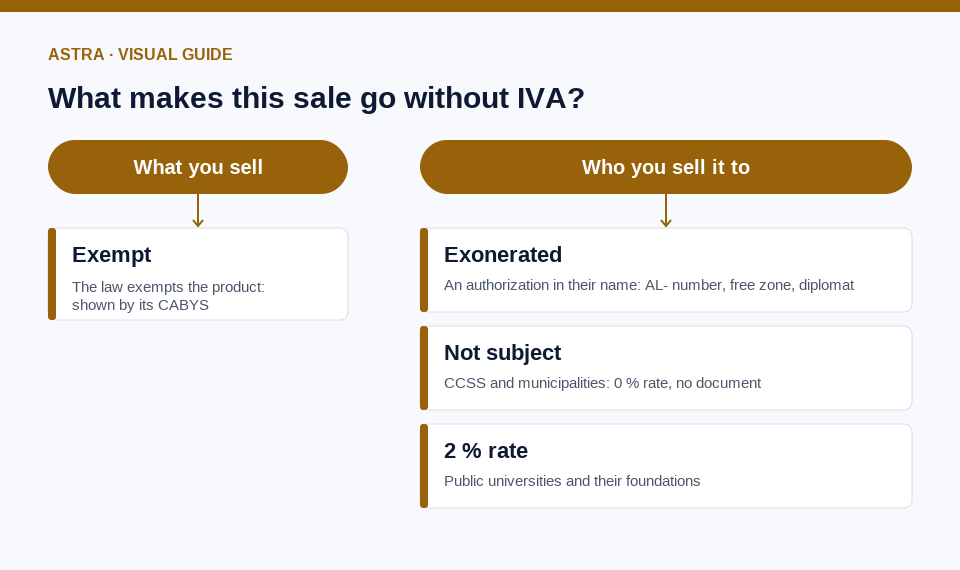
1. Exempt: the product decides
A sale is exempt when the law exempts the good or service, whoever buys it. The list is in article 8 of the IVA law: for example books, recognized private education and home rent below the legal cap.
On the electronic invoice this shows in the product's CABYS code: if Hacienda's catalogue lists it as exempt, the line goes out at the exempt rate. If the CABYS carries IVA and you believe your product is exempt, the code is most likely wrong. In general, the IVA on the purchases used for an exempt sale can't be credited.
2. Exonerated: a customer's document decides
A sale is exonerated when the customer holds an authorization in their name. It is the customer who carries the exoneration, and only with their document: without it, the sale carries IVA.
The common cases: institutions such as the Red Cross, the Fire Department, development associations, school boards or ASADAS, exempt by law but needing a Hacienda authorization in EXONET, numbered like AL-00012345-26; free-zone companies, which buy what they use in their operation without IVA with their purchase order and Acuerdo Ejecutivo; and diplomats, with the card the Foreign Ministry issues.
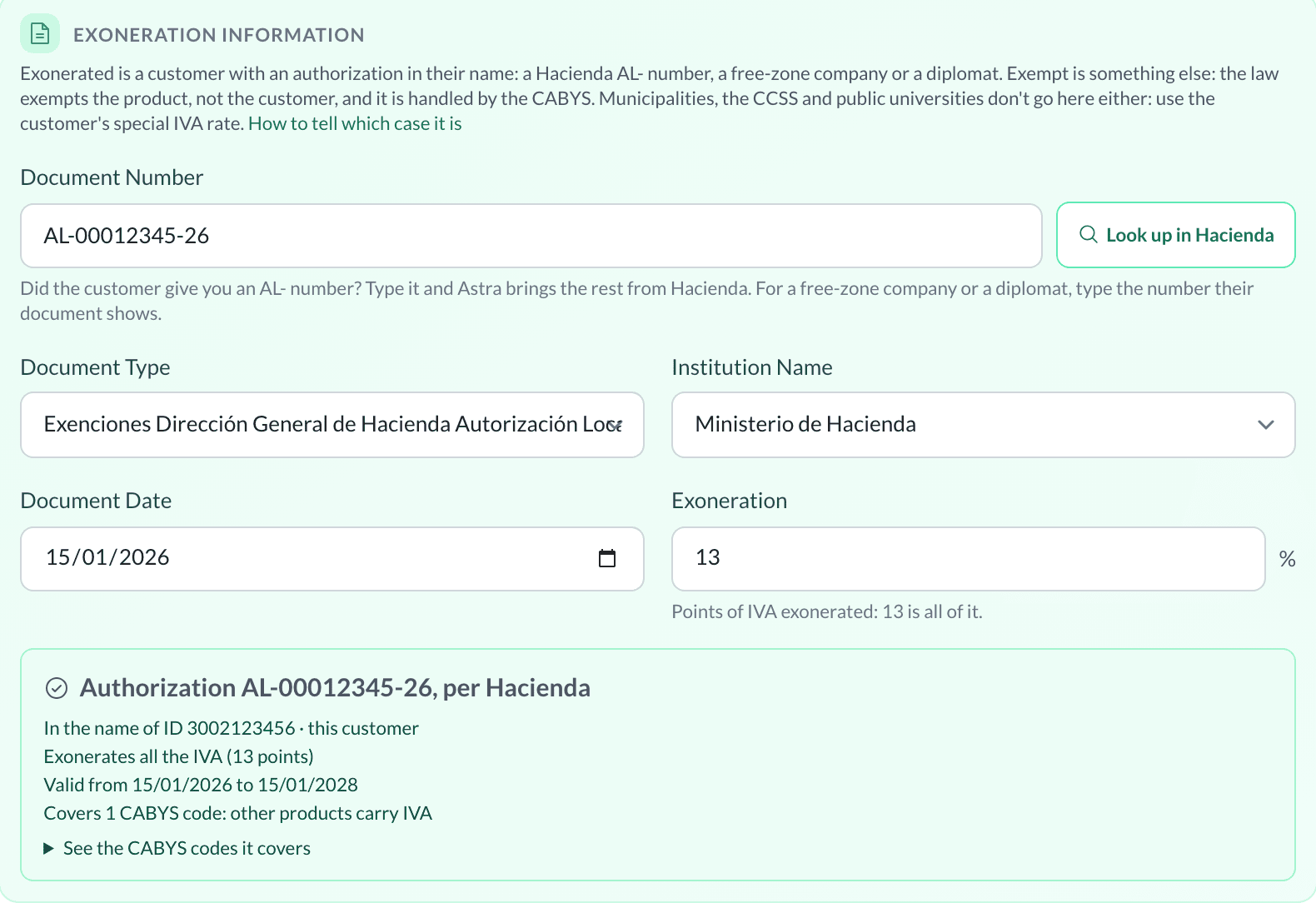
An EXONET authorization has an expiry date and may cover only certain products. Hacienda rejects the invoice if the authorization expired or the product isn't on it. Unlike an exempt sale, an exonerated sale lets you keep the credit for the IVA on what you bought to make it.
3. Not subject and reduced rate: CCSS, municipalities and universities
The CCSS and municipalities, with their cantonal sports committees, are neither exempt nor exonerated: they are not subject to the tax. The sale carries no IVA and no document is needed, but the invoice must be in the institution's name, with its legal ID, and payment must come from an account in its name. You keep the credit on your purchases.
Public universities, their foundations, CONARE and SINAES don't buy without IVA: they pay a reduced 2 % rate on what they buy for their purposes. Ministries, the courts, the Legislative Assembly and the TSE, on the other hand, have paid normal IVA since 2020. The customer being a public institution isn't enough to leave it out.
IVA law, articles 9 and 11 · Legislative Assembly4. How it shows on the invoice and in your return
Each case travels differently on the electronic invoice: an exempt sale at the product's exempt rate; an exonerated one at the product's rate plus the authorization's details (document type, number, institution, date and points exonerated); a sale to the CCSS or a municipality at the 0 % rate; and a sale to a university at the reduced 2 % rate.
An exoneration can be partial: if the authorization exonerates 8 of the 13 points, you charge the remaining 5 %. In the IVA return (Form 150) exempt, exonerated and not-subject sales go in separate boxes, because they change how much of the IVA on your purchases you can credit.
Example: an authorization for 8 of 13 points on a ₡100,000 sale
Full IVA would be ₡13,000. The authorization exonerates ₡8,000 (8 % of the base), so the invoice charges ₡5,000 of IVA.
5. Mistakes to avoid
None of these, on its own, makes a sale go without IVA: check the document or the case before removing the tax.
- Removing IVA because the customer is a company, a public institution or a foreigner.
- Marking as exempt a product whose CABYS carries IVA, instead of fixing the code.
- Invoicing the Red Cross, the Fire Department or a development association without their valid authorization number.
- Using the exempt rate for a free-zone company instead of recording its exoneration.
- Charging 0 % to a public university, which pays 2 %.
Before your next step
- I know whether the sale goes without IVA because of what I sell or who I sell it to.
- I have the exonerated customer's document (AL- number, purchase order and Acuerdo Ejecutivo, or card) and it is valid.
- Sales to the CCSS or a municipality are in their name, with their legal ID.
- I charge public universities 2 %, and ministries normal IVA.
- When in doubt, I ask my accountant before invoicing without IVA.
Where Astra fits
In Astra the exoneration is recorded once on the customer: with an AL- number, the Look up in Hacienda button brings the type, institution, date, points, expiry and the products it covers. Every invoice to that customer applies it by itself, only to covered products and while it is valid.
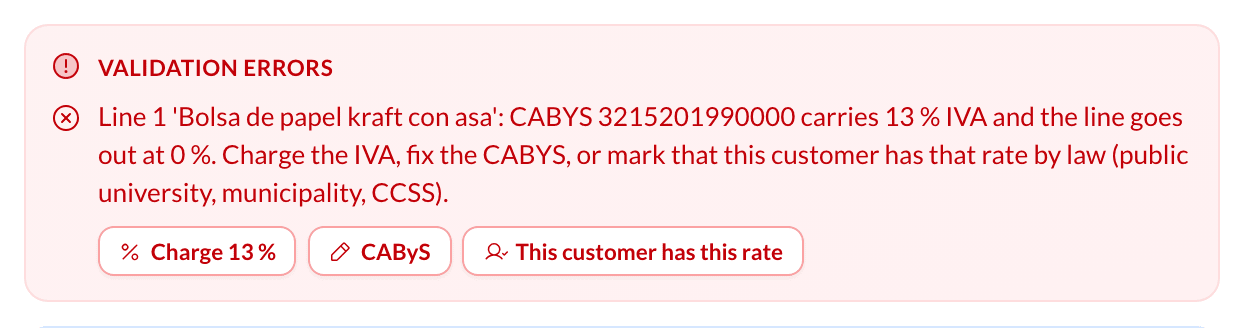
For the CCSS, municipalities and public universities, the customer carries its special IVA rate. Before sending to Hacienda, Astra stops an expired authorization, an uncovered product or a line with less IVA than its CABYS says, with a one-click fix. All of this is part of electronic invoicing, on every plan.
Explore this Astra tool →Frequently asked questions
Is a free-zone company exempt or exonerated?
The law exempts its purchases for its operation, but on the invoice it is recorded as a free-zone exoneration, with its purchase order and Acuerdo Ejecutivo. Confirm with your accountant the law number and article that go on the invoice.
What if the customer's AL- number has expired?
It no longer exonerates: the sale carries IVA. Ask the customer for the new authorization; Hacienda rejects an invoice with an expired one.
Do municipalities need an exoneration document?
No. They are not subject to the tax: no document is needed, but the invoice must be in their name with their legal ID and payment must come from an account in their name.
General guidance for individuals and businesses in Costa Rica. Requirements vary by activity, municipality and institution. Confirm your case with the relevant institution and your accountant or notary.