Bank and card-terminal fees: what goes on the 270 return
Which bank charges are reported on Costa Rica's 270 return, under which code, why the bank doesn't invoice them and how to read a card-terminal settlement.
Every month your bank deducts fees that come with no electronic invoice: the minimum balance, SINPE, the card-terminal commission, the interest on a loan. Since 2026 those charges are reported to Hacienda on the 270 return, which replaced the D-151. This guide explains which ones go in, under which code, what stays out (card-terminal withholdings, taxes) and where reporting them stops short of making the expense deductible.
1. Which bank charges go on the 270
The 270 reports operations not backed by an electronic receipt. In its notice CP-09-2026, Hacienda clarified that in practice this means two things: the fees and interest without IVA charged by regulated financial entities (banks, mutuals, savings and credit cooperatives, brokers and pension fund managers, not insurers), and what an exempt public institution sells you.
For a small business, the part that repeats every month is the bank's. Fees go under code M and interest under code I, one line per bank and code with the month's total in colones. On the TRIBU-CR form the bank's legal ID (cédula jurídica) is enough: the system fills in the name.
There is no minimum amount: a ₡500 fee is reported too. And if a month has nothing to report, you file nothing, because the 270 is not filed at zero. Taxes, stamps, business licences and the vehicle tax (marchamo) don't go in: they are not the sale of a good or a service.
- Minimum-balance or account-maintenance fee: code M.
- SINPE and transfer fees: code M.
- Card-terminal commission, if the bank doesn't invoice it: code M.
- Interest on a loan, an overdraft or a card: code I.
2. Why the bank doesn't invoice you
Almost everything a bank charges is exempt from IVA: interest and fees on loans and credit, transfers, SINPE, deposits and withdrawals, and credit and debit card commissions, including the card-terminal one (article 8 of the IVA Law). And article 84 of the Income Tax Regulation frees regulated financial entities from issuing receipts for services that carry no IVA. That is why those charges only appear on the statement, and why Hacienda asks for them on the 270.
When a bank service does carry IVA, such as a digital signature, a checkbook or a safe-deposit box, the bank must issue an electronic invoice like any business, and that charge is recorded as a purchase. Some banks invoice exempt charges too; BAC, for example, issues invoices for card-terminal charges. Whatever comes with an electronic invoice is not reported on the 270.
One detail worth knowing: the 2018 resolution many sites still quote to say banks don't invoice (DGT-R-012-2018) was repealed in November 2024. The rule in force is article 84, and it only covers what carries no IVA. If a bank charge carries IVA, that IVA can only be credited with the electronic invoice, not with the statement.

3. Card sales: commission and withholdings
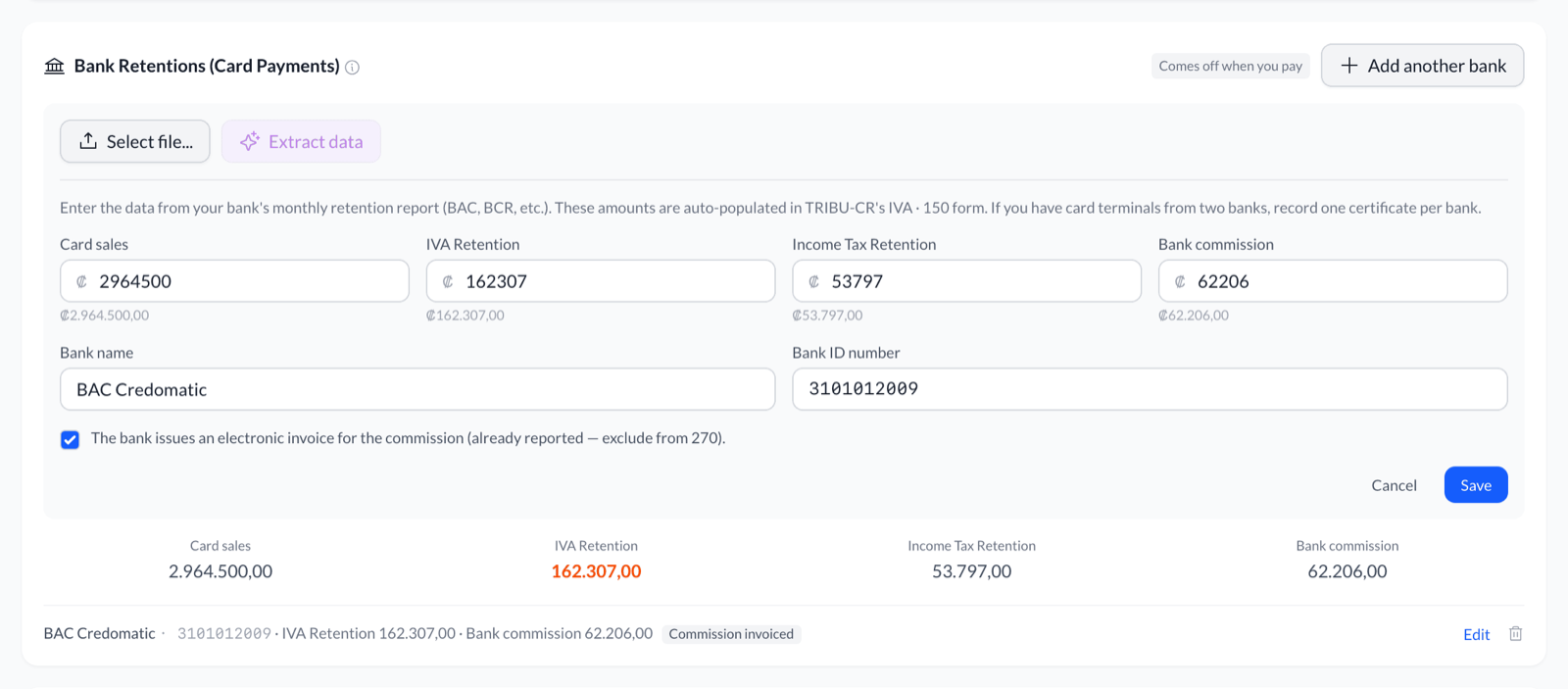
When a customer pays by card, the card-terminal bank doesn't deposit the full sale. It deducts three different things, and only one is an expense:
The card-terminal commission is the expense. The Central Bank caps it at 1.95% of the sale for local businesses, and the terminal rental at ₡14,000 a month. If it comes without an electronic invoice, it goes on the 270 under code M.
The IVA withholding is a prepayment of your month's IVA: up to 6% of the amount before IVA, at the rate Hacienda assigns each business (0, 1, 2, 3 or 6%) based on how much it sells exempt. It comes off the IVA return (form 150). The income-tax withholding is a prepayment of the year's tax: 2% of 88% of the charge, that is, 1.76%. The simplified regime has neither withholding. Neither goes on the 270.
The bank sums it all up in a monthly withholding certificate. Keep it: it backs the prepayments you deduct on your returns.
| Card-terminal commission: 1.95% of ₡113,000 (expense) | ₡2,203.50 |
|---|---|
| IVA withholding: 6% of ₡100,000 (prepayment of the month's IVA) | ₡6,000.00 |
| Income-tax withholding: 2% of 88% of ₡113,000 (prepayment of the year's income tax) | ₡1,988.80 |
| Deposit in the account | ₡102,807.70 |
For a business at the 6% IVA withholding rate with the commission at the cap; your actual rate is on the bank's certificate. Only the commission goes on the 270, and only if the bank doesn't invoice it.
4. Keeping up month by month
The simplest way not to miss a fee is to record fees when you reconcile the bank: every statement charge with no invoice behind it is a fee or interest. If you record them with a manual journal entry, check that the account balance in your system still matches the bank's.
For the 270, add up by bank and code, and file within the first 25 calendar days of the following month. The 2026 months have a special deadline: each one is filed separately by 25 January 2027 (notice CP-14-2026). Not filing a 270 that was due carries a fine of at least three base salaries (article 83 of the Tax Code).
- Reconcile the statement
- Record each fee or interest charge without an invoice
- Record the card-terminal certificate
- Add up by bank and code (M or I)
- File the 270 in TRIBU-CR
If the bank issued an electronic invoice for a charge, that charge comes out at step 4.
5. Reporting is not the same as deducting
The 270 resolution itself states that including an operation does not mean the expense is recognized as deductible. Income-tax law requires expenses to be backed by electronic receipts, and no rule yet says how a bank charge the bank isn't required to invoice gets deducted. Reporting it on the 270 is what Hacienda asks for those charges; how to treat them on the income-tax return is a decision to review with your accountant.
- Putting the card-terminal withholdings on the 270: they are tax prepayments, not expenses.
- Reporting taxes, stamps or the marchamo as payments to the State.
- Reporting a charge the bank already invoiced electronically.
- Filing a zero 270 in a month without charges.
- Assuming everything reported is deductible.
Before your next step
- I went through the statement and recorded every fee and interest charge without an invoice.
- I set apart what the bank invoiced electronically: it is a purchase, not a 270 line.
- I recorded the card-terminal certificate and kept the withholdings apart from the commission.
- I have each bank's legal ID and added up by bank and code (M or I).
- I file the 270 on time, and only in months with something to report.
Where Astra fits
On the Accounting / ERP plans, the bank reconciliation records each fee with Create adjustment from the statement line: the expense goes into the books and the account balance drops just like at the bank. The card-terminal certificate is uploaded in the Tax Summary, and Astra takes the IVA withholding off what you pay for the month and adds the income-tax one to the year's credits.
From ERP Pro, with Accounting Pro, the 270 tab brings it together with the six codes of Hacienda's form: the card-terminal commission comes in by itself from the certificate, and the fees and interest you recorded when reconciling show up by bank, with the suggested code and the legal ID you typed the first time. You file the 270 in TRIBU-CR with that list.
Explore this Astra tool →Frequently asked questions
Which code do I use for the card-terminal commission?
M, the commissions code, same as the bank's other fees. It only goes in if the bank doesn't issue you an electronic invoice for it.
Does interest on the company credit card go on the 270?
Yes, if the issuer is a regulated financial entity and doesn't invoice the interest: it goes under code I, in the issuing bank's name.
Do I have to file the 270 if the bank charged me nothing?
No. The 270 is only filed in months with operations to report.
General guidance for individuals and businesses in Costa Rica. Requirements vary by activity, municipality and institution. Confirm your case with the relevant institution and your accountant or notary.