Accounting basics: profit, cash and what you owe
Understand sales, collections, costs, debts, equity and the three financial statements before preparing a return.
Accounting records and classifies what happens in your business, with supporting evidence. Start by separating what you sold, collected, bought and paid. Those four questions prevent many mistakes before you learn a chart of accounts.
Selling is different from collecting
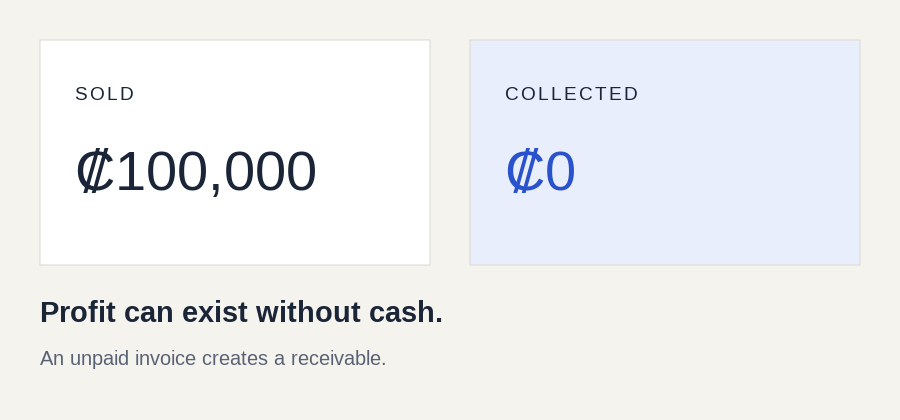
A repair invoiced for ₡100,000 before IVA is a sale. If the customer pays later, you have a receivable rather than that money at the bank. Collection reduces the customer’s debt and increases available cash; it is not a second sale. A quotation is not a sale either.
- Document
- Sale or purchase
- Collection or payment
- Monthly review
Each step has its own record and evidence.
Profit is different from your bank balance
In a simple example excluding tax and other adjustments, ₡100,000 in sales less ₡40,000 in costs and ₡20,000 in expenses leaves ₡40,000 of profit before tax. Profit can coexist with little cash when customers have not paid. Loan proceeds can increase cash without increasing profit.
| Sales excluding IVA | ₡100,000 |
|---|---|
| Costs | − ₡40,000 |
| Expenses | − ₡20,000 |
| Profit before tax | ₡40,000 |
Educational example; it does not calculate your tax or change Astra data.
What you own, owe and retain
Assets include cash, receivables, inventory and equipment. Liabilities include unpaid bills, loans and card debt. Equity = assets − liabilities describes the owners’ net interest; it does not calculate monthly profit. Durable equipment may be an asset whose cost is recognized over time under its applicable treatment.
Three reports, three questions
The income statement explains revenue, costs, expenses and profit for a period. The balance sheet shows assets, liabilities and equity on a date. The cash-flow statement explains cash movements. Read them together, after confirming starting figures and records: a polished report can still be incomplete.
IVA, income tax and evidence
The general IVA rate is 13%, with exemptions and other rates for particular transactions. Collected IVA is not automatically business revenue. Purchase credits depend on eligibility and evidence rather than an assumption of full credit. Accounting profit is not automatically taxable income; review your activity and registered obligations.
Start small and keep a routine
Separate business money from personal money. Retain invoices, XML files, receipts and bank statements, and link payments to their documents. Review outstanding items weekly and reconcile monthly. If your accountant maintains the books, begin with Astra’s existing sales and purchase Excel exports.
How do I know this step is complete?
I chose who maintains my books. Verify the record and evidence, rather than just checking that a notice disappeared.
Before your next step
- I distinguish profit, cash and equity.
- I know which documents and payments remain outstanding.
- I chose who maintains my books.
Where Astra fits
In Astra, My accounting connects optional setup, business tasks and bookkeeping review according to your plan and permissions. Open the relevant tool and verify the result before continuing.
If your accountant maintains the books, existing sales and purchase Excel exports work as before. Completing this path is not required to use them.
Explore this Astra tool →Frequently asked questions
Must I enable books to keep operating?
No. Continue normal operations and give existing exports to your accountant. Accounting setup can be postponed, ignored and reopened later.
General guidance for individuals and businesses in Costa Rica. Requirements vary by activity, municipality and institution. Confirm your case with the relevant institution and your accountant or notary.